The phrase ‘palliative care’ can trigger apprehensions about end-of-life care as something to be regarded with fear and dread.
Dr Jacob Kwak is on a mission to transform the way patients and their families experience palliative care and to challenge outdated views of palliative care.
“Palliative care is not about dying, I really want to emphasise that,” says Dr Kwak, a specialist in Palliative Medicine and Geriatric Medicine at Sydney Adventist Hospital (the San). “Palliative care at its core is about helping people live their best life while facing a terminal illness, and to improve their life experience medically, psychologically, spiritually, socially.”
It integrates best practises from across these fields to provide wholistic patient-and-family-centred care, he adds. “The aim being to optimise function and improve quality of life for those with a life-limiting illness.”
Care That is Personalised and Meaningful
Palliative care often requires longer stays in or more frequent admissions to hospital. The palliative care ward at the San has many special initiatives to enhance quality of life. These are centred on making family time as meaningful as possible and for hospitalisation to be less stressful.
In addition to the longstanding supports in palliative care—such as spiritual care though chaplains, social work, counselling and pain management—one of the significant developments on the San’s palliative care ward is the evolution of the legacy program. Initiated by nurses and doctors on the ward, the legacy program is focused on personalising ways for palliative-care patients and their families to be involved in projects that are meaningful to them.
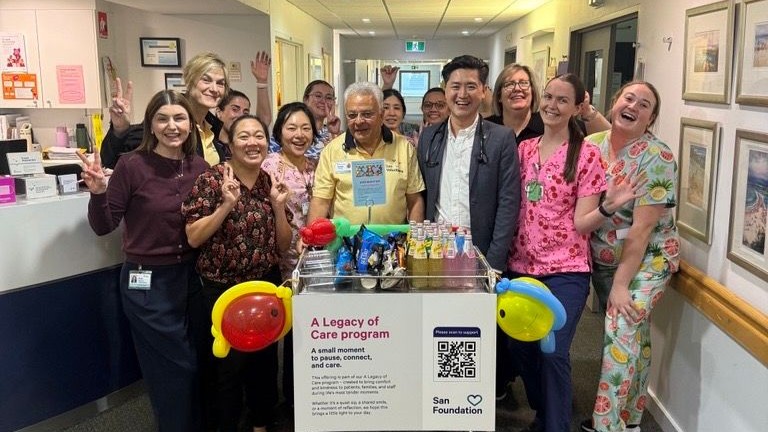
San Kindness Trolley
For some, this means art projects, painting, drawing, writing poetry or recording stories from their life as a legacy for loved ones. Some wish to film messages of love for family, while others want to write letters to their loved ones. If the patient is too unwell or frail to write, volunteers and staff help.
Some patients take the offer of a photography session, where the whole family dresses up for one last family portrait. Musicians volunteer to play the piano or sing, and small ensembles perform in the palliative care garden. Some patients love the idea of having their fingerprint made into a beautiful keepsake piece.
One young father, following a 20-year battle with cancer, was admitted to the San’s palliative care ward. He was unable to walk and required a syringe-driver for pain relief, but he longed to go to his son’s Year 12 graduation. The legacy team rallied some of his mates to take him, making it a very memorable night for the family.
When the legacy program first started, nursing staff and volunteers supplied art materials, but such was the positive reaction from patients and family, the legacy program grew and evolved to the extent that ongoing funding was needed. The San Foundation stepped in with seed funding. Private donors, after hearing about the legacy program or having experienced it for themselves, also make donations.
One man donates Legos to the ward, so children visiting a dying parent have something fun and distracting to do to lessen the strangeness of the hospital setting. The San Foundation donates teddies for children as well.
The San recently purchased a Cuddle Bed; an oversized bed in which partners and/or children can cuddle up together with the patient, helping them feel more at home.
The palliative care ward is also unique because of its Kindness Trolley, stocked with complimentary drinks and snacks. San volunteers, chosen specifically for their affinity with the palliative care ward, take this trolley around to each patient’s room, visiting with them, serving them a treat and chatting to them. It is yet another way to show care and to alleviate the sense of isolation patients can feel at this vulnerable time.
“Too many times over the years, in different places I’ve worked, I’ve seen people die without much preparation or healing before their death,” says Dr Kwak. “The unique situation in palliative care is that there can be a time of preparation between when a terminal illness is diagnosed and when a person passes away. That time is an opportunity to make a difference in the lives of patients and their families. It is truly inspiring to see the legacy program create healing and strength, looking for special ways to support and honour loved ones and build family unity.”
What is created through the legacy program is not just artwork, poetry, letters or photographs, but precious family experiences and memories; fun, healing times together—despite a terminal diagnosis. The legacy program is a very special addition to palliative care services at the San, and a genuine expression of the hospital’s mission: Christianity in Action—Caring for the body, mind and spirit of patients, colleagues, community and ourselves.
To be involved and to donate to the legacy program, visit San Foundation – A Legacy of Care page.
————-
This article was first published at IntraSyd, Autumn 2026.